
Pure Sine Wave Inverter Quality Control & Testing
HOULI applies quality control throughout pure sine wave inverter production, from incoming components and PCBA verification to electrical testing, protection testing, load testing, aging verification and final inspection before shipment.
HOULI Inverter Quality Control at a Glance
Quality control is integrated into the manufacturing workflow rather than limited to final inspection. Different production stages verify materials, electrical performance, functions and assembly consistency.
HOULI Quality Control Facts
- Products covered: 12V, 24V and 48V pure sine wave inverter platforms
- Incoming checks: Electronic components, housings, cables, connectors, displays, sockets and packaging materials
- Electrical checks: DC input, AC output voltage, frequency, load behavior and applicable waveform verification
- Functional checks: LCD display, indicators, remote control, fan operation and applicable USB / PD interfaces
- Protection verification: Low voltage, over voltage, overload, short circuit, over temperature and applicable reverse-polarity protection
- Reliability verification: Load testing, aging testing and final production inspection
- Final control: Product appearance, specification, labels, accessories and packaging
From Production Testing to Final Inspection
HOULI connects production, testing, aging and final inspection within the same manufacturing workflow.
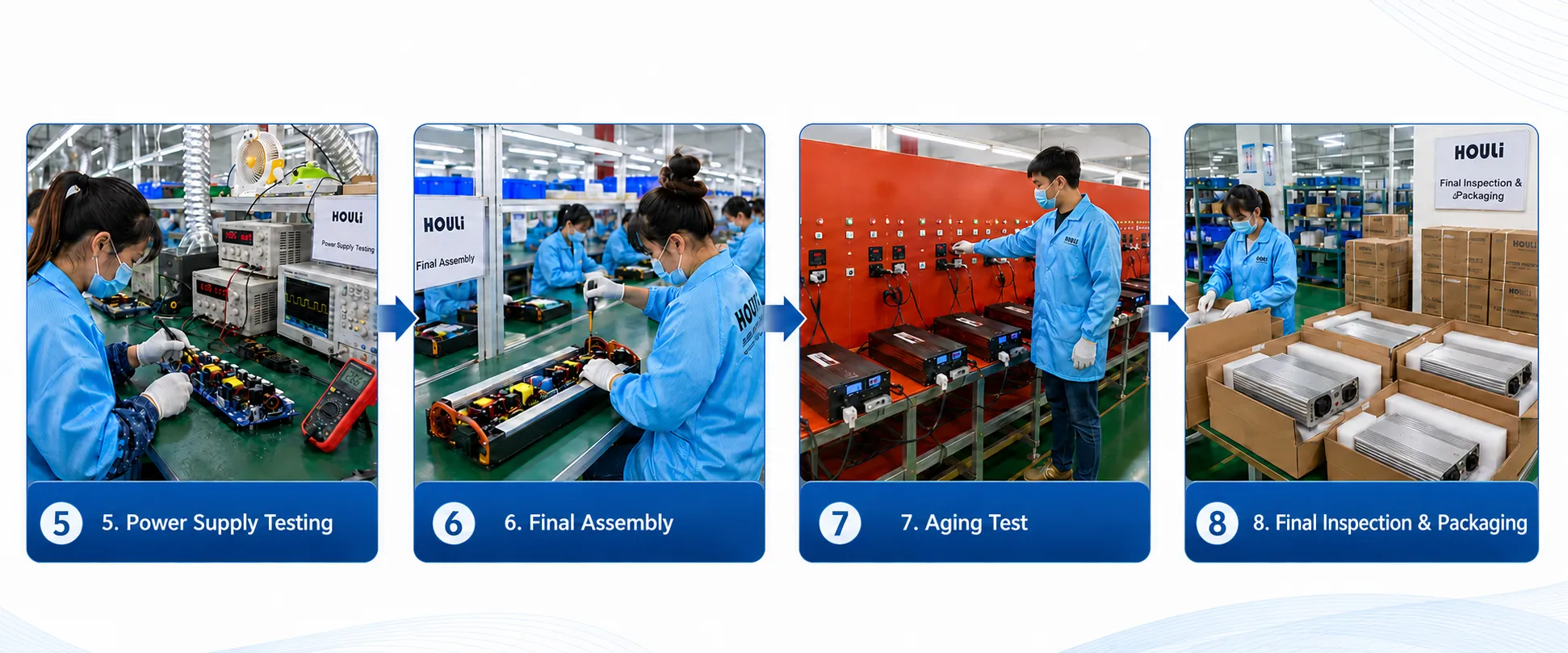
Complete Inverter Quality Control Process
Incoming Material Inspection
Quality control begins before assembly. Incoming electronic components and mechanical parts are checked against approved specifications before they enter production.
- Electronic components
- PCB-related materials
- Housings and structural parts
- Cables and terminals
- Connectors and sockets
- LCD displays and controls
- Packaging materials
Why Incoming Inspection Matters
Component consistency affects electrical performance, assembly accuracy and product reliability. Incoming inspection helps reduce variation before production begins.
Production Process Control
During production, teams follow defined operating procedures for PCB installation, internal wiring, terminal connection, cooling-system installation, LCD integration and housing assembly.
PCBA & Power Module Testing
PCB assemblies and power-related sections are checked before the inverter proceeds into final assembly.
Critical connections and electrical sections are inspected to confirm correct assembly, secure connections and expected circuit behavior.
Electrical & Functional Inverter Testing
Testing parameters depend on the specific inverter model, DC input platform, AC output, frequency, power rating and target-market configuration.
Typical Functional Test Items
Applicable test items are verified according to the approved product specification.
Inverter Protection Function Testing
Protection functions help protect the inverter, battery system and connected equipment. Available protection features vary by model.
Battery Voltage Protection
Applicable low-voltage and over-voltage protection behavior is checked against product specifications.
Load Protection
Overload and short-circuit protection are verified according to the applicable inverter platform.
Thermal & Connection Protection
Over-temperature protection and applicable reverse-polarity protection are checked where supported.
Load Testing & Aging Test
Load testing evaluates inverter behavior under defined operating conditions. The objective is to verify stable operation before products proceed to final release.
Aging verification allows completed inverters to operate for a controlled period so production teams can identify unstable components, assembly issues or abnormal operating behavior before shipment.
What Aging Verification Helps Detect
- Unstable operation
- Abnormal temperature behavior
- Intermittent electrical faults
- Assembly-related issues
- Unexpected fan or display behavior
Final Inspection & Packaging Verification
Finished inverters are checked before packaging and shipment to confirm that the product matches the approved order requirements.
Appearance
Housing, panel, finish and visible workmanship.
Specification
Product model, voltage, labeling and approved configuration.
Accessories
Cables, remote control, manuals and applicable accessories.
Packaging
Cartons, labels, protective materials and shipment preparation.
Quality Control for OEM / ODM Inverter Projects
Customized projects require production control against the approved project specification, not only the standard product specification.
Electrical Specification
DC input, AC output, frequency, power and selected functions are confirmed before mass production.
Product Configuration
Sockets, displays, remote controls, interfaces, labels and accessories are verified.
Branding & Packaging
Logo, nameplate, user manual, carton and private-label packaging are checked against approved requirements.
Explore HOULI Manufacturing & Compliance
Inverter Manufacturer
Review HOULI manufacturing, engineering, product platforms and B2B capability.
Manufacturer ProfileFactory & Production
See SMT processing, assembly, power testing, aging and final production workflow.
Factory & ProductionQuestions About HOULI Inverter Testing & Quality Control
How does HOULI control inverter quality?
HOULI applies quality control throughout production, including incoming material inspection, production-process control, PCBA and power-module testing, electrical and functional testing, protection testing, load testing, aging verification and final inspection.
Does HOULI test every inverter before shipment?
Finished products pass production verification and final inspection before shipment. The exact test items depend on the inverter model, product configuration and approved specifications.
What electrical parameters are tested?
Applicable checks can include DC input voltage, AC output voltage, output frequency, load performance, display functions, remote-control functions, fan operation and selected interface functions.
What protection functions are tested?
Depending on model, testing can include low-voltage protection, over-voltage protection, overload protection, short-circuit protection, over-temperature protection and applicable reverse-polarity protection.
Does HOULI perform inverter aging tests?
Yes. Completed inverters undergo controlled aging and reliability verification to help identify unstable components, assembly problems and abnormal operating behavior.
Does HOULI perform PCBA testing?
Yes. PCB assemblies and power-related sections are checked during production before the inverter reaches final assembly.
How is quality controlled for OEM and ODM projects?
Customized projects are checked against approved electrical specifications, product functions, interfaces, labels, accessories, manuals and packaging requirements before mass production and shipment.
Need Reliable Inverter Quality for Your B2B Project?
Send HOULI your target market, DC voltage, AC output, power requirement, quantity and testing or certification requirements. Our team can evaluate the appropriate product and quality-control requirements for your project.
Request a Quote Discuss OEM / ODM